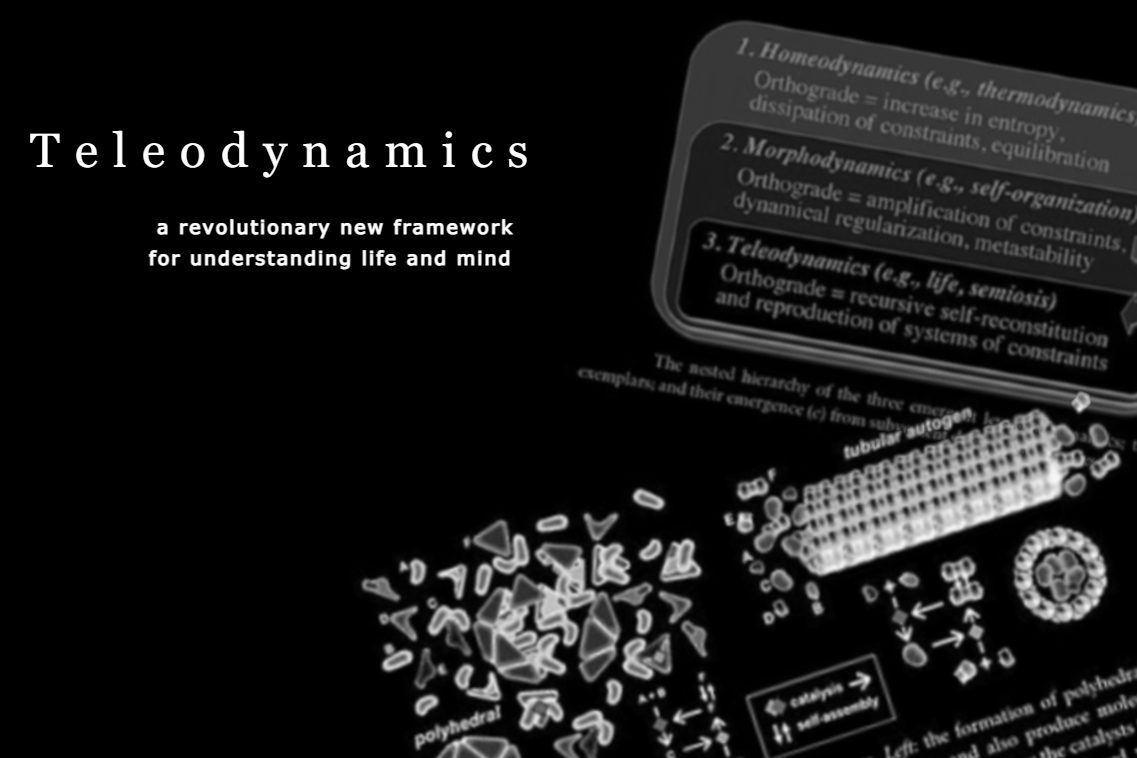

Teleodynamics
How does life emerge in a world that moves lawfully toward disorder? Some have answered this question by suggesting that life is a “self-organizing” process. Self-organizing phenomena, like a whirlpool in a bathtub, produce order by turning the law of increasing entropy against itself. They are systems in which ordered forms may emerge locally in order to increase the rate of entropy production globally. The problem is that these self-organizing processes are also self-undermining: they always exhaust the boundary conditions that make them possible. A whirlpool helps the water drain faster, making the vortex disappear.
Life does precisely the opposite. Rather than increasing the rate of global entropy production, organisms do work in order to resist further entropy increase, allowing them to preserve their forms and maintain their structural integrity. This stark difference reflects a radically different form of organization that we refer to as “teleodynamics.” More specifically, teleodynamics is defined as a higher-order reciprocal relationship between self-organizing processes, in which each process creates the boundary conditions that makes the other possible. This mutual synergy ensures that each form-generating process is brought to a halt before it has the chance to dissipate. For this reason, order is spontaneously generated, preserved, and reproduced.
This simple transition has surprisingly far-reaching implications. Browse the publications on this website to see how teleodynamic theory can provide naturalistic solutions to questions that thinkers have pondered for millenia. These questions include:
- How do normativity and value emerge from the physical world?
- What is conscious selfhood and emotional experience?
- How can physical processes come to “interpret” and “represent” the world? How does a molecule like DNA become “about” other molecules?
- How should we define “information” and how does information produce physical effects?
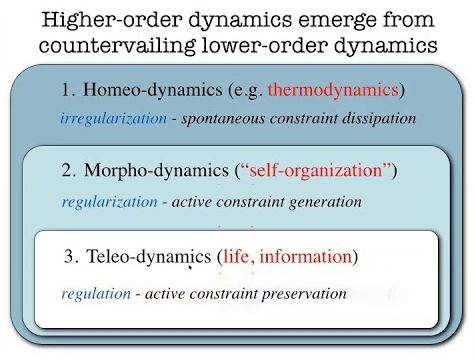
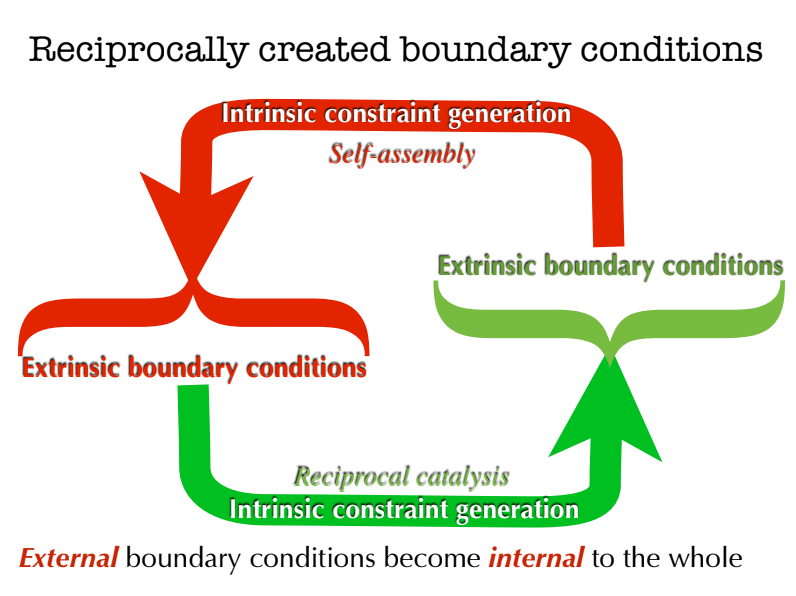
Teleodynamics emerges when multiple self-organizing phenomena generate forms (constraints) that serve as the boundary conditions that make the other self-organizing processes possible, resulting in a spontaneous tendency for the self-generation and self-maintenance of the whole.
 Teleodynamics